
A NEW DYNAMIC AT GBTA, DRIVEN BY AI
As expected, most of the sessions and content at GBTA dealt with AI. The difference between this edition and previous ones is that AI now shows up in practice: in the products, in travel policy, in the travel manager's role and even in the traveler's routine. NDC? All but gone. Not that the topic is fully settled, but AI was the hot subject of this edition.

Coverage and analysis: Alexandre Cordeiro


A GBTA BUILT ON TECHNOLOGY AND ALMOST WITHOUT NDC
By Alexandre Cordeiro, reporting from Chicago
Who could have imagined that NDC would go almost unmentioned at GBTA of all places? The topic has been under discussion for more than ten years, still surrounded by uncertainty, on a path much like the one AI is walking now. Judging by the conversations in the hallways, NDC does appear to be underway: not fully implemented, but on rails. Slowly and in long strides, it became an operational reality. It was only fair that it made room for another relevant subject. Welcome, AI. Or perhaps not so welcome, given the uncertainty and the gap between what AI already offers and how prepared companies are to absorb it.
AI in the hallways. AI in the education sessions. AI at lunch. AI at happy hour. AI. What I heard from executives, travel managers and founders, however, was far from dazzled: we use AI, but there are consequences we are still feeling. The perception repeated itself with variations and the same underlying point: this is an industry built on control, governance, security and predictability, and AI still carries uncertainty about where it leads. The discomfort comes from the distance between what it promises and what a travel program can actually sign off on while preserving the governance that corporate travel demands by nature.
Across those days there were many product launches that were, in fact, available. Less PowerPoint and more finished product. Conversational search, analytics, automation, connected agents. It left the planning stage, perhaps helped along by how much easier AI makes shipping a product.
Part of that novelty, though, points backward. An old concept returned in new clothes: open booking. For years it was the name for a reservation made outside the company's preferred channel, with the traveler buying directly from the airline site or an OTA while the program chased the data, the duty of care and the lost spend. Back then it was the booking outside the preferred channel; today it is AI, which is not only another channel but one that operates outside policy. The innovation challenge is the same as it was ten years ago. What changed is the transformation cycle, now brutally shorter. Where does that leave the industry? That is the question running through the pages ahead.
The answer, neither straightforward nor fully formed, comes in four movements: what has left the hype behind and entered practice, and what is still booth decoration; why static policy does not survive a traveler who already operates with AI of their own; how travel managers and their companies absorb AI and make it part of the process, which is exactly the question I took to the stage at the GBTA Business Travel Forum São Paulo in June and which produced the From Hype to Hands-On playbook; and why Brazil, after decades of visiting GBTA as the mecca of what was new, came back from this edition with more to teach than to learn.
This material exists because Panrotas and Mobility made the Travel Tech Hub trip to Chicago possible.
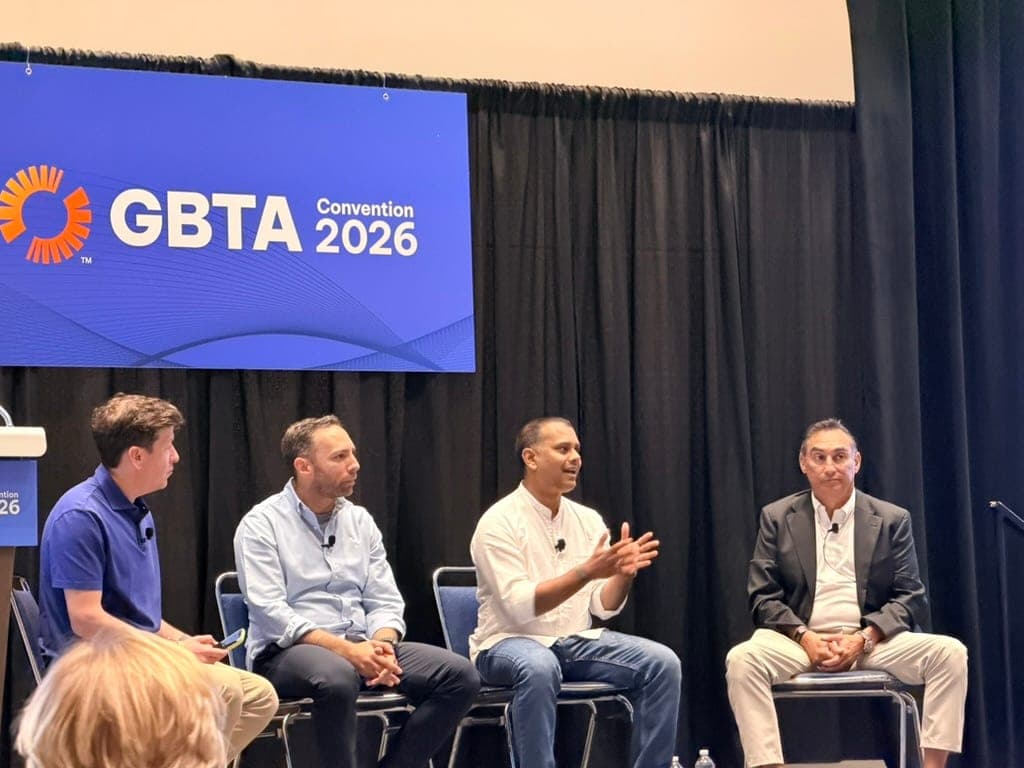
FROM HYPE TO HANDS-ON
AI dominated the hallways and the stages at GBTA. What is new is that it is now available in products, processes and launches.
Photo: Travel Tech Hub
THE BUILD AND DELIVERY CYCLE HAS SHORTENED.
What used to take years became possible in months or weeks. The GBTA 2026 launches are the proof: AI embedded in the workflow and, above all, available.
In a TTH talk at the GBTA Business Travel Forum São Paulo in June, which gave rise to the "From Hype to Hands-On" playbook, the pace of change was framed in three boxes: what was once a cycle of years became a cycle of months and now runs in weeks, sometimes days. Anthropic, the company behind Claude, shipped 74 releases in 52 days, roughly 1.4 per business day. A feature can become obsolete while it is still profitable, because the profit reflects ground already covered. The sooner you see the cycle, the sooner you start moving. Chicago confirmed the thesis two months later: a market that had been discussing AI as a future and a doubt can now see the results and press real buttons.
Years
How it was: long cycles, roadmaps measured in annual versions
Months
How it became: quarterly releases turned into the norm
Weeks, sometimes days
How it is now: a new feature lands before the previous one is absorbed
- 74
- releases by Anthropic, the company behind Claude, in a single cycle
- 52
- days to ship all of them
- 1.4
- releases per business day, on average
Source: talk "AI in travel management: from Hype to Hands-On", GBTA Business Travel Forum São Paulo, June 2026; The Product Compass
The list of launches was long: FCM Travel presented conversational booking inside FCM Booking, filtered by policy, profile and traveler history, running first inside Teams and Slack with planned expansion, via MCP, to ChatGPT, Claude and Gemini. Accelya launched SPRK Assist, covering 37 NDC servicing use cases in which the agent describes the desired outcome in natural language and the system locates the booking, validates contractual conditions and calculates fares. TripGain announced its MCP server. Direct Travel rebuilt Avenir as a multi-agent architecture on top of Spotnana. Cerebri presented expense agents with Moderna as its first named client. Conversational search, NDC, agents: exactly the package any good observer had predicted, now with an availability date attached.
Launches and announcements: GBTA 2026
| Company | Launch |
|---|---|
| FCM | Conversational booking, inside Teams and Slack, with expansion via MCP |
| Accelya | SPRK Assist, 37 NDC servicing use cases, with BCD as partner |
| TripGain | MCP server |
| Direct Travel | Avenir rebuilt as a multi-agent architecture on Spotnana |
| Cerebri | T&E agents, with Moderna as first named client |
| Emburse | Partnerships with Cvent and Direct Travel |
| Conferma | Global benchmark for virtual card performance |
Source: press releases distributed at GBTA 2026
In practically every launch, the human, largely the travel manager, remains the final authority by product design, not by technical limitation. In SPRK Assist, the agent prepares and the human confirms. In FCM Booking, policy filters first and the consultant stays in the loop. "We didn't build FCM's technology ecosystem to replace our consultants' judgement. We built it to take the routine work away", said John Morhous, Chief Experience Officer at FCM. That is neither accident nor modesty: fully replacing human teams with AI has already proven unsuccessful wherever it was attempted, both in quality of delivery and in cost, promising efficiency and delivering rework. The market learned, and the product design of 2026 carries the scar.
It is the same conclusion the most provocatively titled debate of the convention reached by another route. In the session "NDC Is Dead: Long Live King AI", the screen opened with a challenge: "NDC has been 'the future of distribution' for over a decade. AI got there in 18 months." Along the way, the session weighed the NDC promise against the delivery: rich content and branded fares stalled on GDS economics, personalization at the point of search remains uneven and, as the screen itself put it, every airline implemented NDC its own way, and the standard never truly standardized. Forty-five minutes later, the closing slide dismantled the provocation: coexistence, not a cage match. The verdict, written on screen: "AI on top of NDC, not instead of it". AI as the interface and decision layer; NDC and GDS remain the plumbing.
“NDC has been ‘the future of distribution’ for over a decade. AI got there in 18 months.”
MARKETING POWERED BY AI
A booth without AI on its walls was almost impossible to find. The marketing rule must be: fit AI in wherever it is needed, but fit it in.
It was enough to walk the expo floor with some attention: if a booth did not have "Powered by AI" on the walls, it was probably emptier than the neighbors that did. The same pressure that pushes travelers to adopt AI pushes product marketing to promote it. Not having it is a disadvantage, at least in the mind of whoever signs off on the campaign.
Even so, GBTA's own survey of 169 travel managers in North America and Europe measured the real temperature of the programs: 58% report little or no impact from AI so far. Only 2% describe a dramatic improvement. And 38% of buyers cannot say whether their own TMC uses AI in servicing. Interest, on the other hand, is close to unanimous: 93% want AI-generated reporting, 92% want predictive analytics, 89% want automated disruption management. Low usage, very high desire: the classic portrait of a technology caught between the announcement and the operation.
- 169
- travel managers responding
- 65%
- North America35% Europe
- 59%
- global programs26% multinational, 15% domestic
- 35%
- with 5,000 travelers or more32% under 1,000
Source: GBTA survey "Innovation and the 'Perfect Trip'", 2026
| No impact | 29% |
|---|---|
| Little impact | 29% |
| Some impact | 30% |
| Considerable impact | 10% |
| Dramatic improvement | 2% |
58% report little or no impact. Only 2% describe a dramatic improvement.
Source: GBTA survey "Innovation and the 'Perfect Trip'", 2026 · n=218
| AI-generated reporting | 7% 93% |
|---|---|
| Predictive analytics | 5% 92% |
| Automated disruption management | 7% 89% |
| Policy chatbot | 15% 88% |
| Policy recommendations | 5% 87% |
| Receipt capture | 15% 87% |
Source: GBTA survey "Innovation and the 'Perfect Trip'", GBTA Convention 2026
Vinicius Gonçalves, CMO of TourHouse, brought back from one session the summary he heard from a travel manager at a large company: trying to automate a process with 30 systems involved may well be garbage in, garbage out.
For Manuela Bernardes, Executive Director of Flytour Business Travel and Flytour Eventos, citing data presented in a session: infrastructure, engineering and marketing already use AI in more than 70% of their daily work; in travel, fewer than 30% of travel managers use it as a required part of the routine. "In travel, we are still finding our way."
The Travel Tech Hub read: vendors stamp AI on everything because they know the market demands it as proof of value; the client, however, does not yet feel it in the program, given the implementation stage. Whoever closes that loop first will most likely hold a significant competitive advantage.
DYNAMIC TRAVEL PROGRAMS
The travel policy in PDF is on its way out as a meaningful travel manager deliverable. The question in 2026 is whether the rules that once made sense survive a confrontation with reality, and AI is precisely the tool that makes that confrontation possible every day, second by second, transaction by transaction.
ADOPTION ARRIVED BEFORE THE RULE
The immediate effect of innovation, when it takes hold, is rapid adoption that arrives before the legislation, the policy and the institutional design. It was the common thread across every education session: the traveler already uses AI. And is not going back.
In more than one education session, travel managers described the same scene: travelers using AI to build itineraries, compare prices and, in growing numbers, to buy. The data released that week showed the scale of it.
Amadeus called it shadow AI: 62% of American corporate travelers have already used their own AI to plan or book outside approved channels, 20% do so regularly and only 9% say they never would.
SAP Concur, surveying 3,300 travelers across 21 markets, found 72% willing to use unsanctioned tools, with 85% of CFOs concerned and 73% considering it likely that AI is already being used to falsify expenses.
Travelport mapped the funnel: 32% research with AI, 8% complete the booking through it. Trust to assemble options, 76%; to spend on their behalf, 44%. And 80% require seeing the tool's reasoning before letting it act.
- 76%
- 73%
- 44%
- Trust AI to assemble options
- Trust it to build itineraries
- Trust it to spend on their behalf
80% require seeing the reasoning before letting it act
- 62%
- have used their own AI outside approved channels (Amadeus)
- 72%
- willing to use unsanctioned tools (SAP Concur)
- 32% vs 8%
- research with AI vs complete the booking through it (Travelport)
Source: Travelport Traveler Confidence Survey; Amadeus Tailored Horizons; SAP Concur
The detail linking the data to the product showed up on media day: in the FCM conversational booking release, every recommendation comes with the reasoning attached, showing why it fits policy, why it matches the traveler's usual route and loyalty program. "Conversational booking only works if travelers trust what they're being shown, and that trust comes from context, not just convenience", said Jessica Dunderdale, Global Head of Product at FCM. It is the direct answer to the 80% who require seeing the reasoning before letting the tool act.
AI is the new Google, remember (and for the older among us, it is also the Office suite on a résumé). The comparison deserves to be taken seriously in everything it implies, because the change is not one of channel, it is one of behavior. It changes how every system delivers value. It changes how travelers look for the first information about a trip and a destination. It changes how they compare fares, hotels, flights and neighborhoods. It even changes the calculation between renting a car and calling an Uber. It therefore changes the dynamics of the entire market. And it should change how we generate value as an industry and as participants in it.
The market has already lived through a dress rehearsal of this, and the name is worth recalling: open booking. Last decade, the term described a booking made outside the preferred channel, and programs responded with an arsenal of capture: itinerary integrations, email parsing, reimbursement policy conditions. Shadow AI is open booking 2.0, with one aggravating factor that changes the category of the problem: AI is not merely another channel outside the preferred one, it is a channel that reasons outside policy.
Hence the question every travel manager asked in the hallways: how do you catch up with that adoption? Chasing the traveler is running a race already lost, with the added cost of turning the travel program into a police force. There may be another way: to embrace AI not as a single miraculous tool but as part of a set, an ecosystem of tools that supports and advances the corporate travel ecosystem as a whole. The traveler comparing neighborhoods in ChatGPT is not an offender, and may well be an unpaid beta tester for the travel program of the future, or something close to it.
BE WATER, TRAVEL POLICY
Advance purchase requirements, city caps, per diem ceilings: do the rules that once made sense still make sense today? For the first time there is a tool to answer that question continuously, rather than once per RFP.
The travel policy in PDF has stopped being a travel manager deliverable. That statement, which I presented in São Paulo two months before the convention, came back from Chicago validated. More than the file format, what died was the logic: a set of rules written once a year, approved in committee and tested against reality only when somebody complains. Do the rules on advance purchase, city caps and category ceilings really hold up when measured against what the program actually spent? How many companies can answer that with a number?
AI can bring the speed and the analytical power not only to answer the traveler but to adjust the rule: to make policy and the travel program dynamic, a set of parameters that still pursues control and governance while understanding the nuances of a market in constant motion.
In the GBTA BTF São Paulo playbook, this became a practical exercise, run live by the audience: a reviewer agent that compares what policy defines against the program's actual history, delivered against expected, and points out where the rule promises and fails to deliver. "The advance purchase requirement promised savings, but they were imperceptible" is the kind of sentence no committee writes and the data always reveals. Be water, travel policy: water takes the shape of the glass, and policy should take the shape of the operation, not the other way around.
The week's numbers suggest travelers may accept that transition better than managers do: in the Amadeus survey, 18% already trust AI more than themselves to comply with company policy, and 66% would let the tool rebook a cancelled flight on its own. What nobody accepts yet is the grey zone of accountability: when an AI-made booking goes wrong, 38% blame the assistant, more than the airline (30%) or the agency (19%). Amadeus's own report calls this a genuine liability question. Until the answer arrives in a contract, it has to arrive in policy: who authorizes the agent, up to what amount, with what audit trail. A dynamic policy is not a loose policy. It is a policy that changes because of the data, not out of habit.
- 38%
- blame the AI
- 30%
- blame the airline
- 19%
- blame the agency
The ownerless question that every 2027 contract will have to answer.
Source: Amadeus Tailored Horizons, 2026
“If AI is invisible, that’s a sign that they’ve got it right.”
The context
Only 31% of buyers state that their TMC uses AI in servicing; 31% say it does not and 38% do not know. On stage, the reading that turned the embarrassment on its head: well-implemented AI does not show up; better service does.
The counterpoint
The expo floor bet on the opposite: AI as a badge, the more visible the better. Between the invisible AI that works and the branded AI that sells, GBTA 2026 lived with both. Only one survives contract renewal.
THE ROLE REVISITED
THE PROOF OF VALUE IS NOT IN THE TRIP ITSELF
It is in orchestrating the entire ecosystem: travelers, tools, suppliers, stakeholders, budget and an ROI that has to mean more than savings. The travel manager's role is being challenged and revisited.
This avalanche of new capability forces a rethink of the value a travel manager can generate for the organization. The CFO wants to know why the program costs what it costs. The C-level wants to know what the function delivers beyond a cheaper ticket. And the answer that worked ten years ago, "savings on travel", has shrunk: savings became a commodity that every tool promises. The proof of value moved from the trip itself to the orchestration of the whole ecosystem: travelers, tools, suppliers, stakeholders (CFOs and C-levels at the head of the table), budget and an ROI tied to the business, not to the fare or the savings.
The GBTA survey quantified the chaos every global manager already knows: on average, 5.3 OBT instances and 5.3 expense instances per multinational program. Five environments, five sources of data that do not talk to each other. No AI orchestrates something fragmented that way, and no conductor leads five orchestras playing different scores. Before the agent, the inventory; before the automation, the tidying up. It is the corporate version of the garbage in, garbage out of those 30 systems that Vinicius Gonçalves, of TourHouse, brought back from a session.
The fragmentation no agent solves on its own.
Source: GBTA survey, 2026
How should that new role be pursued through technology and AI? The answer I argued for in São Paulo, and which Chicago reinforced, has three layers. First, a real increase in analytical capacity: the travel manager who does not read data outsources the decisions to whoever does. Second, a change in posture: turning the travel program into a compass for value creation rather than a set of hard rules to be obeyed; the yardstick stops being "how many exceptions did I block" and becomes "how much value did the program create for the business". Third, AI attached to the routine, not as a special project with its own committee and budget.
A provocation, then, and it is individual rather than institutional: look at your skills, at your set of tools and at your role in the company, and ask honestly how to absorb this avalanche. Yes, avalanche. It is not an exaggeration for the volume of change this paper documents on every page, and an avalanche is not managed the way a breeze is managed: it demands revisiting the role, not merely defending it. The professional who takes that inventory now gets to choose what changes; whoever delays will receive the change fully formed, chosen by somebody else.
“Examine your skills, understand how new tools can support the revisiting of your role, and how you create value.”
The session "Brains + Bots" gave the same movement a framework name: AI Readiness, Intelligence & Governance and Human Boundaries, the three pillars of the reimagined travel buyer. The third pillar is what holds up the other two: identifying where human judgement is indispensable, and the boundary no panelist at the convention contested is that crisis management is not delegated to an agent. The model standing in every product and every framework is the same, and I summarized it in this month's Travel Leaders Hub column: the agent suggests, the person decides.
| Pillar | What it requires |
|---|---|
| AI Readiness | Protecting data and engaging suppliers securely |
| Intelligence & Governance | Governance and lessons learned before the first project |
| Human Boundaries | Where human judgement is indispensable |
Source: session "Brains + Bots: Designing Travel Strategy in the Era of Agentic AI", GBTA 2026 (Richelle DeGuzman-Smith, GoldSpring; Suzanne Boyan, ZS; Gee Mann, Travlr ID)
TRAVEL MANAGER 2.0: FROM ROLE TO PROJECT
In São Paulo, the audience ran the exercises live, phones in hand. In Chicago, large corporations showed the same logic applied to the most traditional instrument of the profession: the RFP.
The "From Hype to Hands-On" playbook, which grew out of the talk at the GBTA Business Travel Forum São Paulo, starts from one premise: nobody learns AI by watching a talk about AI. The five challenges were run live, with the audience photographing prompts from the screen and executing them in their own tools. The second challenge asked for exactly what Chicago would confirm two months later: act as Travel Manager 2.0, produce KPIs that complement the classic ones from finance, procurement and compliance, and design a plan for the professional to evolve their own set of roles. The fifth took the exercise to a real project: a four-sprint plan combining AI, the manager's knowledge and the partner's API. The distance between the travel manager who administers rules and the one who builds solutions has never been so small, nor so decisive.
In the session on evaluating OBTs and alternatives to the RFP, Matt McClellan, Global Travel & Fleet Leader at GE Aerospace, described abandoning the classic RFP for technology procurement: the company runs two paid pilots in parallel, with roughly a thousand real travelers each, and decides on production data rather than form responses. Rosemary Maloney, Senior Director of Corporate Travel at Freeman Company and GBTA president, kept the RFP but moved discovery earlier and priced the SLAs. Two routes, one shared premise: an AI tool is not evaluated on a written promise. Written promises, incidentally, are what the traditional RFP produces best: whoever answers the form best is rarely whoever runs the product best.
| So-so | 42% |
|---|---|
| It is poor | 26% |
| It is decent | 22% |
| It is excellent | 6% |
| Cannot say | 4% |
68% rate it average or worse. Only 6% consider it excellent.
Source: live poll (Slido), session on hotel content, GBTA 2026 · n=77
The thread connecting São Paulo and Chicago is the same: the professional who executes end to end, with AI in the workflow, has gained a power the traditional structure does not grant. The concept has a name in the market, the High-Impact Contributor: someone who delivers an entire valuable project alone, with AI, without depending on a team or headcount to create impact. For the travel manager, it is less a threat than an invitation: impact and relevance start to count for more than title and team size.
LESS LEARNING, MORE CONNECTING
SCARCITY BREEDS CREATIVITY AND AI CLOSED THE GAP
For decades, technology, processes and best practices were born in the American market and Brazil consumed them as novelties. The Brazilian executives we interviewed came back from Chicago with a different diagnosis.
Historically there was a wide distance between the American market and the Brazilian one. Technology, processes, tools and best practices were born and developed there; we consumed them as novelties. It was understood that this was the best on offer, and we visited GBTA as the mecca of the new. The 2026 edition buried that script. The trip became less about learning and more about connecting, debating and understanding a way of working. Carolina Gaete, of Voetur, who has attended the convention for 18 years, sums up the arc: there was a time when talking about OBTs felt remote; today "we are very close, and Brazil has something to teach". Aline Bueno, CEO of Argo Solutions, with more than 15 GBTAs behind her, says she spent 13 of them wondering when all of it would reach Brazil, and that this year she watched the distance "shrink considerably". Manuela Bernardes, of Flytour, went further: "we are not behind in anything".
There are even areas where we are further along, out of necessity. Payments is the clearest example, and it is not only about PIX: virtual card numbers embedded in the transaction, automatic reconciliation, anti-fraud layers that the American market is only beginning to discuss, while Conferma launched at the convention itself the first global benchmark for virtual card performance.
Even Brex, exhibiting at GBTA, tells that story: you cannot say it was created in Brazil, but Brazilian creativity is in the product's foundation and nobody can take that away. Pagar.me was born to solve the complex problems of our market; we exported a piece of that complexity in the form of competence in its founders. No inferiority complex here: this is genuine pride.
Brazil, because of its complexities, did not only get to learn over all those years: it now had to be able to teach. In payments, as the executives we interviewed pointed out, the pain in our market was severe and the urgency just as strong. We were more anchored in a scarcity of resources and technology than the Americans were, and precisely for that reason we held them up as the great reference. They still are, in specific verticals and subjects. But AI changed a structural variable in the game: for the first time, frontier technology is available on the same terms and at the same price to every market. And when the tool is the same, what differentiates is the repertoire of whoever uses it. Perhaps markets accustomed to scarcity will fare better. Creativity sharpens in settings where there is less resource than the task requires. That Brazilian knack for making do, always a diagnosis, has turned into a competitive advantage.
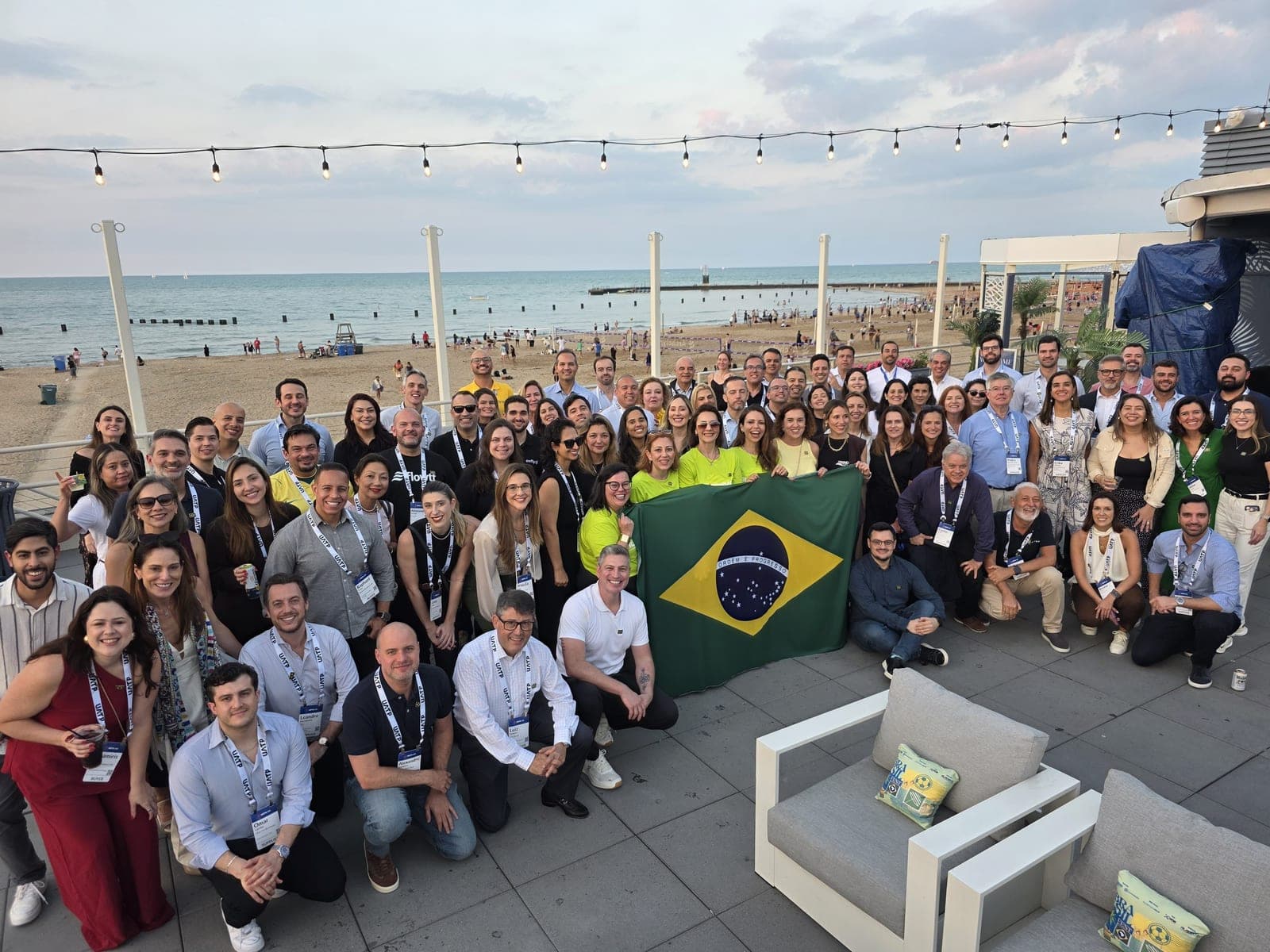
“With AI available on the same terms and at the same price to everyone, markets accustomed to scarcity may well fare better.”
Pride does not excuse us from honesty, and the counterpoint came from the interviewees themselves. On strategic maturity the tables turn: in the United States, whoever owns the category holds an executive seat; in Brazil, travel is still a cost line at most companies. On AI governance, Carolina Gaete saw policies and finished products there that are still missing here. And there is a gap that is not technical but cultural: Brazilian executives still hear "I don't know that market" at the booths. Brazil's deficit at GBTA is not one of repertoire, it is one of recognition, and recognition is built by showing up. The official data helps build it: Brazil growing 13.8%, the fastest pace among the world's 15 largest markets, in a year when global spend reaches US$1.71 trillion.
- 13.8%
- growth in Brazil, the highest in the top 15
- 10th
- largest market in the world
- US$1.71 tn
- global spend in 2026
Source: BTI 2026, GBTA
EVERYONE AT THE SAME STAGE OF THE GAME
If one sentence sums up GBTA 2026, it is this: everyone is at the same stage of the game. The American travel manager and the Brazilian one share practically the same governance doubts. The global supplier and the local travel tech run the same short cycle. Some may be further ahead, the travel techs among them, precisely because of the delivery pressure the market puts on anyone who lives off a product. But nobody has the map ready, and whoever says they do is selling a booth.
The second conclusion concerns the role of whoever manages: evolved, not replaced. This was never a contest between AI and travel policy, nor a confrontation between AI and the travel manager. AI arrives attached to the routine, part of the work, exactly as the Office suite arrived three decades ago: without ceremony and without a way back. The interview question changed from "do you know Excel?" to "can you orchestrate agents?", and the window to learn is open now, while using AI is still cheap and mistakes are still allowed.
See also · A Bússola
The thesis about a new way of producing, which runs through this paper, is developed at length in the August edition of the Travel Leaders Hub column: "From Working to Producing", by Alexandre Cordeiro. Published in Portuguese.
Read the full column on PanrotasCREDITS AND SOURCES
Read the full coverage on the hub
- FCM Travel launches AI conversational booking (in Portuguese)
- Shadow AI: 62% already book outside approved channels (in Portuguese)
- Brazil leads growth with a 13.8% rise (in Portuguese)
- Accelya launches SPRK Assist for NDC servicing (in Portuguese)
- From Hype to Hands-On playbook (in Portuguese)
- Travel Leaders Hub column: From Working to Producing (Panrotas, in Portuguese)
Sources cited
- GBTA (BTI 2026; survey Innovation and the "Perfect Trip")
- Amadeus (Tailored Horizons, with Mercury Analytics)
- SAP Concur (Wakefield Research survey, 21 markets)
- Travelport (Traveler Confidence Survey)
- The Product Compass
- Press releases distributed at GBTA 2026 by FCM, Accelya, Direct Travel, Emburse, Conferma, Cerebri AI, Oversee, TripGain, Lyft, NLA, Preferred Hotels, Radisson, SilverDoor
- Exclusive interviews with Travel Tech Hub
- TTH talk at GBTA BTF São Paulo 2026
Who we interviewed in Chicago
- Alexandre MottaManaging Partner · Conex Travel
- Bruna HeusiGeneral Manager · TripService
- Luana NogueiraExecutive Director · ALAGEV
- Carolina GaeteCommercial and Global Partnerships Director · Voetur Viagens
- Gian TerhochCEO · TourHouse
- Aline BuenoCEO · Argo Solutions
- Manuela BernardesExecutive Director · Flytour Business Travel e Flytour Eventos
Interviews given to Travel Tech Hub during the GBTA Convention 2026 in Chicago. Conducted in Portuguese and translated by AI. Quotes edited for concision, with meaning preserved. Photos: Travel Tech Hub.
MADE POSSIBLE BY


The Travel Tech Hub trip to GBTA 2026 and the production of this paper.
GBTA 2026 Tech Paper · Travel Tech Hub · traveltechhub.com.br · Corporate Travel desk
FROM HYPE TO HANDS-ON: THE SÃO PAULO PLAYBOOK
The exercises cited throughout this paper came out of the talk at the GBTA Business Travel Forum São Paulo in June and became an open playbook. If you want to run what is described here, the full material is there. Published in Portuguese.
The reviewer agent, in 3 steps
- 1Feed the AI your current policy and ask for an impartial critique: 5 improvements and 5 modern ways to deliver experience without losing control.
- 2Compare the rule against actual spend history.
- 3Turn the findings into an evolution agenda with stakeholders.
What is in the playbook
- 5 challenges run live
- 20 prompts
- 10 skills and GPTs
- 5 configurable agents
- A glossary of 50 terms
DOWNLOAD THE FULL PAPER
The same content as this page, laid out for offline reading and internal circulation. No form, no email required.
WHAT TO READ NEXT
From Hype to Hands-On playbook
The 5 challenges, 20 prompts and 5 configurable agents from GBTA BTF São Paulo.
Open the playbookCorporate Travel
The hub's continuous coverage of TMCs, OBTs and travel management.
See the deskTravel tech glossary
NDC, MCP, VCN, OBT: the terms in this paper explained one by one.
Look it upTTH community
Where this conversation continues among the people running travel tech in Brazil.
Join